


At POLIMI Graduate School of Management's annual event, findings from the Purpose in Action Observatory reveal that one company in four still lacks a clear AI strategy, while only 13% of managers believe AI systems have clearly defined objectives
The third edition of the Purpose in Action Observatory, developed by the School of Management of Politecnico di Milano in collaboration with Adiacent and Ipsos Doxa, was previewed during the event. More than seven managers out of ten believe that Purpose will play a central or significant role in guiding the responsible use of AI over the next five years.
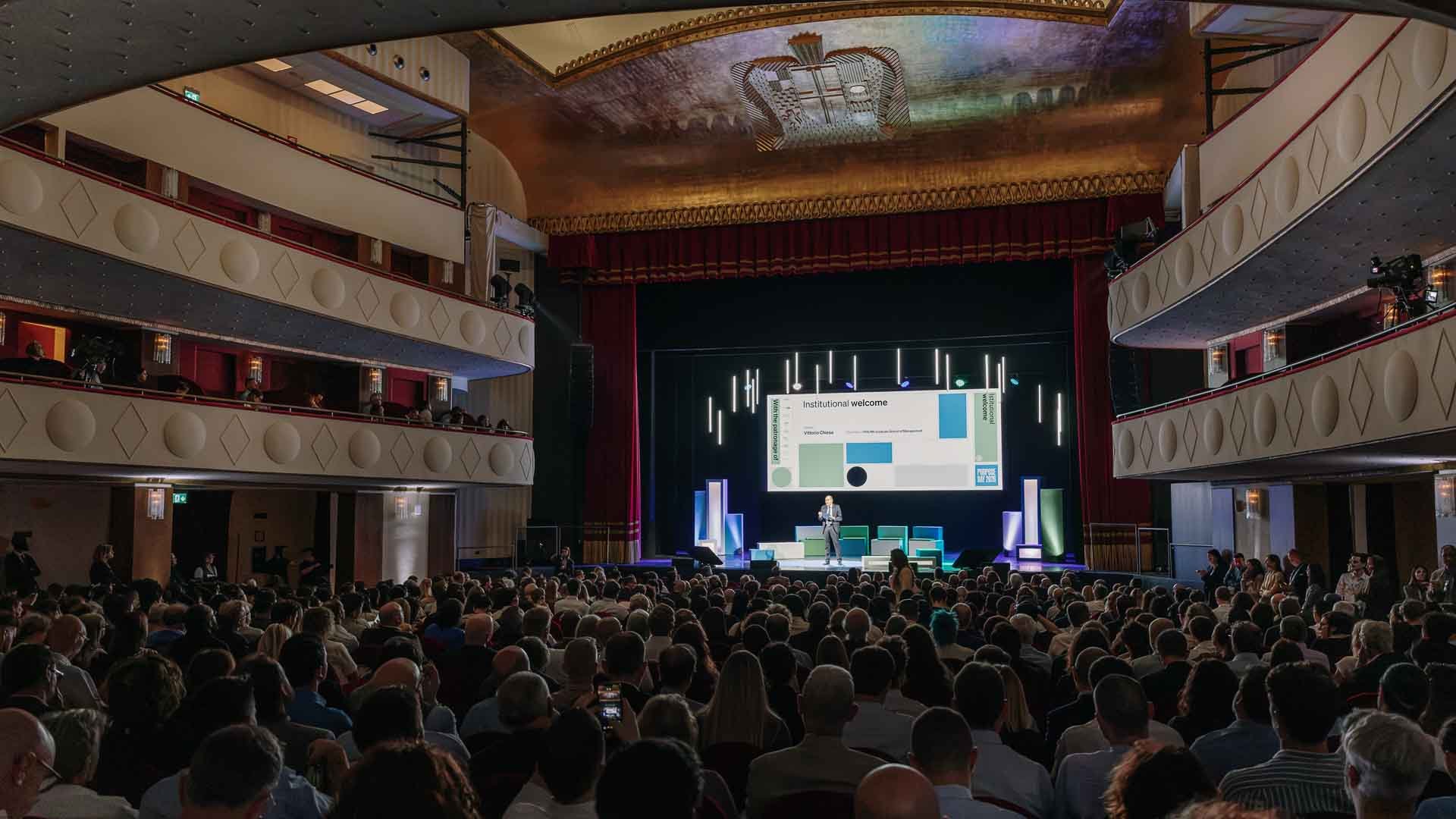
More than 1,800 participants, both in person and online, took part in the fourth edition of Purpose Day, the event organised by POLIMI Graduate School of Management entirely dedicated to Purpose and held, for the second consecutive year, in collaboration with the Purpose Center of HEC Paris. This year's theme, "Driving Technology to Shape Meaningful Futures", guided a day of discussion focused on how Purpose can provide direction for technological transformation, ensuring that progress results from conscious choices rather than simple inertia.
At the heart of the event was the presentation of the 2026 Purpose in Action Observatory Research, now in its third edition, developed with Adiacent as Strategic Partner, Ipsos Doxa as Insight Partner, and with the contribution of Workday. Conducted on a sample of 612 managers from companies operating in Italy, this year's study explores the relationship between Purpose, work and talent in the age of artificial intelligence.
The findings reveal a paradox: artificial intelligence has already entered organisations, including areas that directly affect people, yet companies still struggle to govern it effectively. AI is currently used to support managerial decision-making by 30% of organisations, for workforce and skills planning by 27%, and for performance evaluation by 25%. However, one company in four (27%) still lacks a clear approach to AI. For 60% of managers, AI adoption is driven solely by efficiency and cost reduction. Only 13% fully recognise that the objectives assigned to AI systems are clearly defined. Technology is therefore spreading more rapidly than organisations' ability to establish its purpose, boundaries and accountability. To provide direction, managers increasingly look to Purpose: more than seven out of ten believe it will play a central or significant role in ensuring the responsible use of AI over the next five years.
The leadership challenge also remains unresolved. The research highlights that organisations are not yet prepared to manage hybrid teams composed of people and AI systems. Only 9% of managers consider their organisation fully ready to lead teams in which people and AI work side by side. Among the capabilities deemed most necessary, technical skills (48%) are closely followed by critical thinking and the ability to assess automated decisions (44%). Change management and data literacy follow at 42%. In the agentic era, the human advantage is shifting from execution to interpretation and judgement.
"For Italian companies, Purpose is no longer a matter of definition but of implementation, and artificial intelligence makes that transition increasingly urgent," commented Josip Kotlar, Co-Scientific Director of the Purpose in Action Observatory. "If Purpose remains merely a statement, AI risks being adopted according to what technology makes possible rather than what the organisation is seeking to achieve. If, instead, it becomes the criterion through which goals, boundaries and responsibilities are defined, it can provide the compass that is currently missing."
"In this context, Purpose offers a clear direction: it helps organisations understand why AI should be adopted, where it should be applied and what value they ultimately want to create," added Paola Castellacci, CEO and Chairman of Adiacent SpA.
The research also confirms that Purpose has now become firmly embedded in the language of Italian businesses. 65% of managers are able to articulate their company's Purpose, while 38% of organisations can be considered fully purpose-driven. The first tangible effects are evident in investment decisions: 39% of companies are placing greater emphasis on innovation and sustainable digital transformation, while 24% are financing projects with lower financial returns but greater social or environmental impact. Internal organisational change, however, remains slower, with only 15% having structurally redesigned roles and responsibilities.
"Purpose Day was created to shift the conversation from what technology can do to what we choose to do with it," said Vittorio Chiesa and Federico Frattini, President and Dean of POLIMI Graduate School of Management. "This year's participation and our collaboration with HEC Paris confirm that organisations increasingly recognise this topic as their own and that the debate has now acquired a European dimension, in which Italy can play a leading role."
Held at Milan's Teatro Lirico Giorgio Gaber, the event brought together international leaders, CEOs and academics. Key speakers included Charles Conn (President of Patagonia), Rebecca Henderson (John & Natty McArthur University Professor, Harvard University), Mauro Porcini (President and Chief Design Officer of Samsung), Melissa Ferretti Peretti (Vice President and Country Manager of Google Italy), Rodolphe Durand (Academic Director of the Purpose Center of HEC Paris), Mario Cucinella (Founder and Creative Director of MCA – Mario Cucinella Architects), Paola Castellacci (CEO and Chairman of Adiacent SpA), Roberto Verganti (Stockholm School of Economics and Harvard Business School) and Stefan Krook (serial entrepreneur and impact investor).
Purpose Day 2026 is organised in collaboration with Phoenix Group, an integrated consultancy, corporate finance, innovation and operational services group supporting financial institutions, insurance companies, payment operators and industrial businesses, with an established presence across Italy, Europe and the United States; RATP Dev Italia, the global mobility operator of the RATP Group active in 16 countries; and SD Worx, Europe's leading provider of HR, payroll and workforce management solutions. Forbes Italia is the event's media partner.
The event is also supported by AIDAF, AIDP, AIMBA, Assintel, Associazione Alumni Accenture, ANDAF, ASFOR, ASSOBENEFIT, Assolombarda, IICCI - The Indo-Italian Chamber of Commerce and Industry, AHK Italien, Camera Nazionale della Moda Italiana, Club Uomini Gentili, Companies Talks, CoLAP, Confindustria Lombardia, Digital Industries World, Digital Innovation Days, Ecosistema Formazione Italia, Elis (CONSEL), Fabbrica Italiana dell'Innovazione, Federmanager, Fondazione Fimelato ETS, Fondazione S. Carlo, GWPR Italia, Fondazione IDI, Liberi Dentro, Lifegate, MADE Competence Center, ROAD Rome Advanced District, Task Force Italia and U.NA.P.P.A.