




From the difficulty of finding work to skills misalignment: why finding your way today is increasingly complex
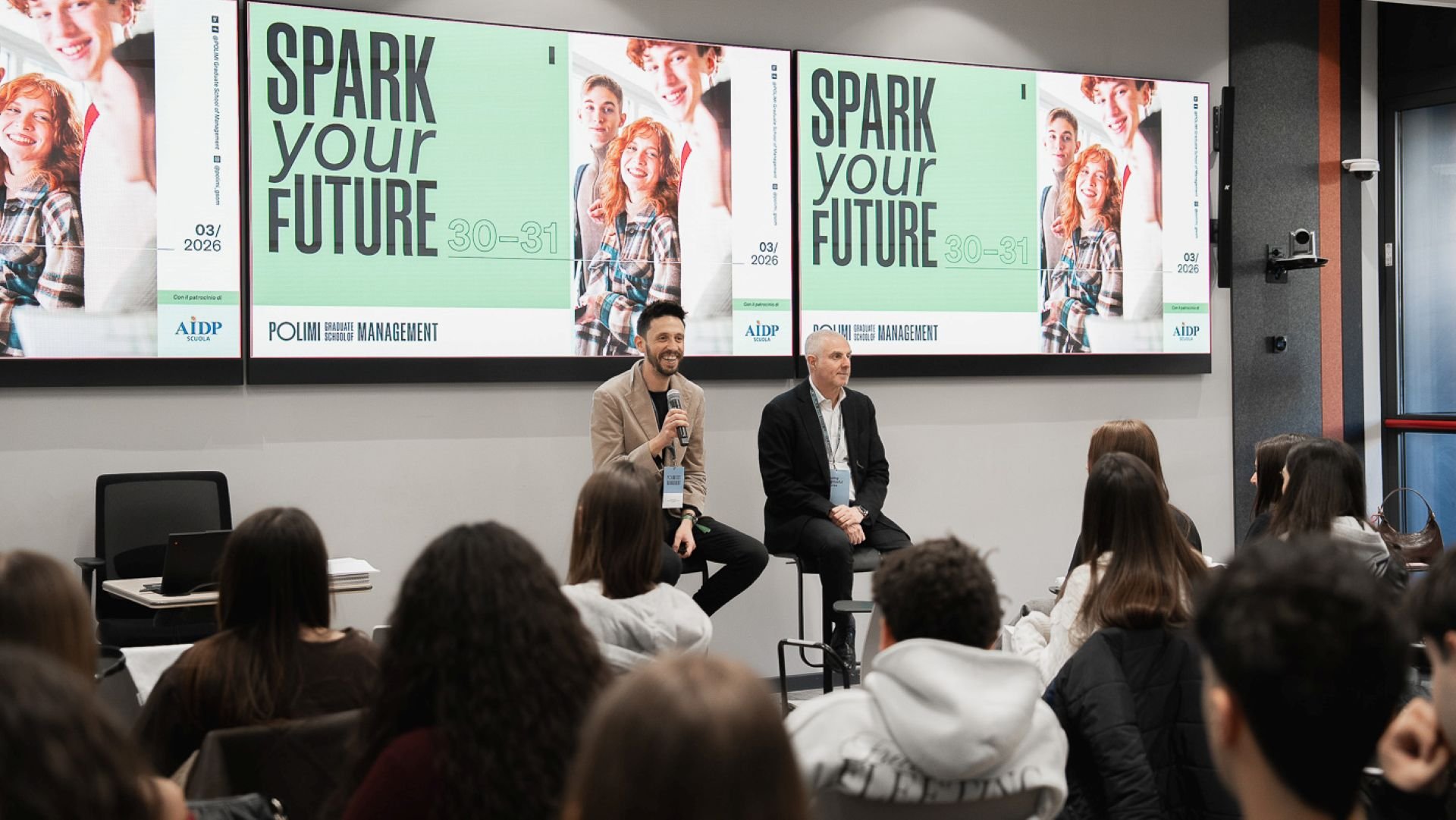
Understanding your professional future in a context marked by social uncertainty, technological transformation and global instability: this is the challenge at the heart of Spark Your Future, the initiative promoted by POLIMI Graduate School of Management, which on 30 and 31 March involved approximately 300 high-school students at the Navigli campus.
“Today, the challenge is not just creating opportunities, but helping young people find their way in a context where the rules of work are changing faster than educational pathways. The risk is that there will not be any alignment – either between job supply and demand, or between expectations and reality," commented Enrico Bellazzecca, Associate Dean for Sustainability & Impact at POLIMI Graduate School of Management.
Conceived within the Impact Committee – the advisory board tasked with guiding the School in addressing sustainability challenges and developing effective strategies aimed at maximising the positive impact of its activities – the initiative represents the second project developed from the Committee’s reflections, with the objective of creating concrete guidance opportunities for the younger generations.
A real problem: young people are increasingly distant from the world of work
The initiative is part of a context in which the transition from school to work is increasingly complex. As highlighted by the latest data on the NEET phenomenon in Italy, conducted by Fondazione Gi Group’s “Dedalo – Permanent Laboratory on the NEET phenomenon”, young people neither in education nor employment represent 14.5% of the youth population, while the youth unemployment rate stands at around 18.9% (ISTAT data, January 2026).
At the same time, companies are struggling to find staff: according to the CNEL–Unioncamere report, 46% of positions are difficult to fill, a figure that rises to over 50% for graduate roles.
This paradox highlights a structural mismatch between available skills and business needs, compounded by a rapidly changing global environment. According to the Future of Jobs Report 2025, about 39% of current skills will have changed by 2030, while for 63% of businesses, the skills gap is now one of the biggest barriers to growth.
Two days to interpret the future (and understand how to navigate it)
Over the course of two days, the students – mainly from the fourth and fifth years – were involved in a structured programme combining inspirational moments with hands-on workshop activities.
Divided into three classrooms, participants participated in talks and workshops dedicated to three key areas: social impact and inequalities, with a focus on educational vulnerabilities and opportunities for inclusion; technology and artificial intelligence, to understand how skills and professions are changing; and geopolitics and new global professions, to understand the transformation of work in an interconnected world. The approach is designed to go beyond traditional guidance, encouraging active participation and critical reflection.
From the content that emerged during the initiative, it is clear that the current context requires young people to possess not only technical skills, but also to have transversal abilities. In an increasingly unstable and interconnected world, the following become crucial:
- adaptability and continuous learning;
- critical thinking and the ability to interpret change;
- interpersonal and cultural skills.
At the same time, technological acceleration − particularly when linked to artificial intelligence − is profoundly transforming professions, making hybrid and non-linear career paths increasingly common.
Guidance as a strategic lever for the country's economic system
Orientation is not just about individual students, but about the economic system as a whole. The difficulty companies face in finding suitable skills is, in fact, a real brake on growth and competitiveness.
In this scenario, initiatives such as Spark Your Future highlight the need to strengthen the dialogue between schools, universities and the world of work, anticipating ongoing transformations and supporting young people in making more informed choices.