


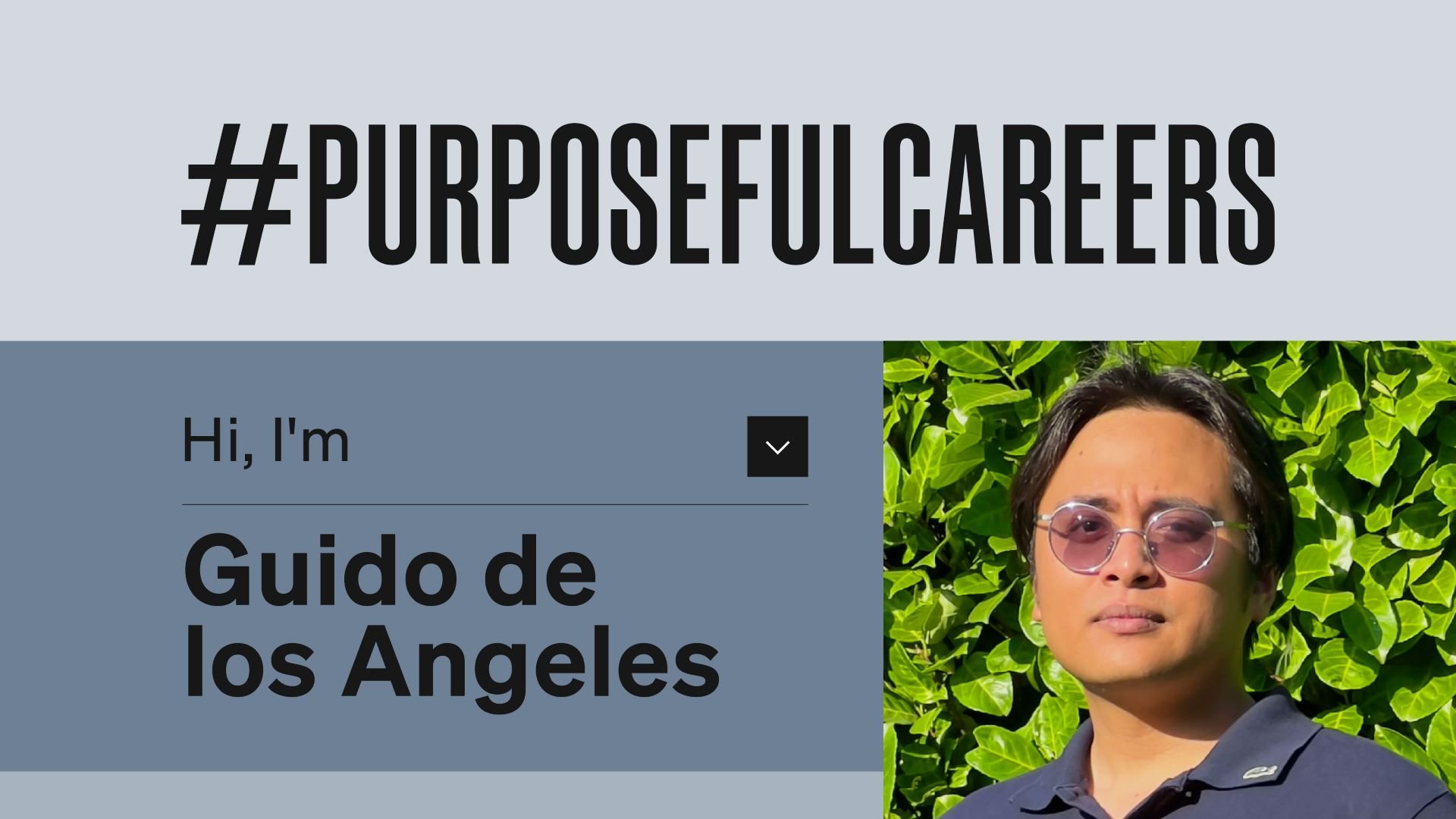
In this new chapter of Purposeful Careers, we meet Guido de Los Angeles, a Full-Time MBA participant whose professional journey has taken him from media and marketing to entrepreneurship in the environmental infrastructure sector.
In his story, a clear belief emerges: creating meaningful social and environmental impact requires the same discipline, strategic thinking and operational rigour that drive successful businesses. From launching and growing a venture focused on sustainable wastewater treatment solutions in the Philippines to building an organisation capable of addressing complex infrastructure challenges, his journey shows how purpose and entrepreneurship can reinforce one another to create lasting value.
A direction that the Full-Time MBA has helped strengthen, providing new perspectives on financial strategy, organisational growth and global business standards while supporting his ambition to build a resilient business capable of generating long-term impact for both communities and the environment.
You transitioned from a successful career in media and marketing to launching a startup focused on wastewater treatment with a strong social impact. What were the key challenges in making this shift, and how did this experience shape your purpose as an entrepreneur?
If you look at both industries in isolation, you’d be forgiven for thinking that they can’t be any more different from each other. On one side you have the fast paced world of marketing and corporate media strategy, on the other you have a very traditional industry in the form of construction. In reality, however, I discovered that a lot of operational aspects are remarkably similar. Both activities require a deep understanding of complex, multi-stakeholder environments, practicing smart and rigid capital allocation, and the ability to drive behavioral change at different scales.
The immediate challenge I remember facing when I entered the space was that you learn very quickly that nothing is what it seems. I came from a world where everything was instantly visible through dashboards, data was always at an arm’s length and you had an infinite amount of frameworks for analysis to do your job. When you transition from an industry like that it’s quite daunting to stare the sheer opacity of a highly traditional, engineering-heavy industry in the face. Imagine the learning curve of project management in heavy civil works, navigating intricate regulatory compliance, and the complexity of procurement in the context of fragmented supply chains all at the same time.
On the flip side I saw a profound competitive edge that most of our competitors don’t have. In a traditional sector like infrastructure, technical expertise is everywhere, but commercial agility, institutional brand positioning, and structured client-relationship management are rare. My experience in handling large-scale business development and corporate marketing lent itself surprisingly well and allowed our venture to establish rapidly growing market credibility. It continually enables us to translate complex engineering processes into a clear, risk-mitigated business narrative for our clients, helping our company achieve net profitability within our very first year of operations.
This shift fundamentally shaped my purpose as an entrepreneur. I realized that driving true social and environmental impact doesn't mean moving away from the ebbs and flows of corporate rigor, if anything it means leaning into it. My partners and I share the view that true sustainability is achieved when heavy environmental infrastructure is managed with the same financial precision, corporate visibility, and strategic discipline as any high-growth global enterprise.
For anybody reading this who might be thinking of taking the leap, I feel it important to mention the personal aspect. In hindsight, this is something crucial I remember waking up one day and asking myself “what have I gotten myself into?”, that tinge of self-doubt I think can be very disruptive but is very human, especially when you transition from a stable office job to starting a company from scratch in a completely different industry where literally anything can happen, in a context where certainty is a luxury. The good news is that when you reflect deeply on your purpose, on your ‘why’, you instantly have the response for when those questions pop into your mind. You’ll be surprised at your ability to forge ahead humbly and eliminate second-guessing. As your organization grows, that purpose gets wrapped beautifully into a greater sense of responsibility towards your people who rely on you, and by extension, the people who rely on them.
Your venture aims to improve access to sustainable water solutions in the Philippines while engaging local resources and communities. Looking ahead, what kind of impact do you hope to generate through your business, and how do you see your role evolving in driving both economic and social value?
Our opportunity lies in showing the market that investing in environmental infrastructure can drive genuine value. At this stage we’re demonstrating that wastewater treatment infrastructure can be economically viable and operationally robust. In the Philippines, the wastewater landscape is undergoing a structural shift. For decades, wastewater treatment was treated as an afterthought, a low-priority compliance expense. Today, regulatory mandates from the Department of Environment and Natural Resources (DENR), specifically DAO 2016-08, the updated DAO 2021-19 with another mandate we’re expecting to be released next year have and will continue to raise the stakes significantly, effluent violations mean compounding daily fines, the type that can run companies out of business if not paid attention to. Fundamentally, a severe infrastructure deficit continues to be problematic in the Philippines. It’s a situation where rapid urbanization consistently outpaces centralized sewage networks and commercial and industrial enterprises face an existential threat to their operations if they fail to manage their wastewater treatment effectively.
We realized early on that a systemic challenge of this scale can’t be solved by a solo founder wearing too many hats, or a fragmented team trying to do everything all at the same time; it requires an institutional-grade organization with the agility of a small company. From day one, we structured Ecosphere Builders Inc. around a balanced, co-founding trio where each of us three founding partners manage different pillars of the business. One partner focuses entirely on the technical engineering and people management on the ground; another is an expert in sales, business development, and heavy project delivery; while my office handles corporate finance, the treasury, and building our institutional brand equity.
This structured approach has thus far allowed us to achieve market validation ending our initial launch phase with strong net profitability. As we approach our one-year milestone this July, our execution pipeline has rapidly matured. We have scaled from deploying compact, localized systems for institutional clients, such as the construction of a specialized facility designed to treat 100-cubic-meters-per-day (CMD) for a school expected to become operational this August, to securing a formal corporate accreditation with a premier national conglomerate in the country with others currently in the works.
Returning home to the Philippines this July to resume full-time operational control feels less like a return to work and more like entering a second phase of the organization’s growth. We are currently preparing for substantial capital injections in the near term that will boost our corporate liquidity and fund larger enterprise deployments. Our objective is to sustain and build on our strong initial momentum while configuring the organization to scale into a resilient enterprise. Strategically, our focus is on shifting client conversations away from simple, transactional project delivery towards a model that actively accompanies and scales with the dynamic requirements of treating wastewater and navigating an increasingly strenuous regulatory landscape. In an industry where traditional providers often treat the completion of construction as the finish line, effectively leaving clients to navigate complex, shifting compliance risks entirely on their own, we view the handover as just the beginning. We want to prove to the market that true long-term value is driven by sustained operational oversight, ensuring that our clients maintain airtight compliance while actively and consciously safeguarding public health in the densely populated metropolis of Metro Manila and eventually, the entire country.
You chose to pursue an MBA to further develop your entrepreneurial vision and connect it to a broader global and “Made in Italy” perspective. How has the experience at POLIMI Graduate School of Management helped you refine your purpose, and what key capabilities are you building to scale your venture and create long-term impact?
Sitting in a lecture hall in Milan while your company is actively executing heavy industrial projects 10,000 kilometers away is a surreal exercise in dual-mindedness. It’s like trying to cook two different dishes at the same time. You are constantly toggling between immediate operational realities back home and the high-level academic frameworks in front of you.
For me, choosing to pursue a Full-time MBA at POLIMI Graduate School of Management was never about taking a break from entrepreneurship, it was an intentional RCD phase to stress-test our business model against world-class benchmarks on one end and reinforcing it alongside a cohort made up of professionals in different fields from different parts of the world on the other end. I was lucky enough to share the experience with people with whom I had the most enriching conversations in every context you can think of, some of which I will be working actively with from here on out. That’s where I find the real value of the MBA, it lies in the relationships you develop both on and off campus.
Living and studying in Milan fundamentally changed how I look at industrial assets. In the heavy B2B sectors, I discovered that the "Made in Italy" ethos is so much more than a design element or a nationalistic sticker on a wheel of cheese, it is a masterclass in precision engineering, extreme spatial efficiency, and total asset optimization. Back home, our industry has traditionally been constrained by a reliance on massive, capital-intensive concrete structures that demand enormous physical footprints and months of disruptive civil works. Immersing myself in the European industrial landscape refined my purpose. It inspired me to champion a shift toward a decentralized, high-efficiency design framework. By bringing that Italian focus on well-crafted structural agility into our pipeline, we can offer systems that radically minimize the physical and environmental footprint a company needs to achieve compliance.
Beyond the engineering philosophy, the MBA gave me the rigor and the fluency in financial engineering required to scale an infrastructure firm safely. Scaling a business in an emerging market means constantly staring down macroeconomic volatility. Thankfully, deepened capabilities in advanced corporate finance, capital structuring, and risk mitigation were fruits of the Full-Time MBA at POLIMI GSoM. The experience has also rewritten my approach to our corporate treasury. I find myself not just looking at our growth rate; I’m looking at how we can manage cross-border supply chains, manage currency depreciation and foreign currency exposure, and allocate capital to insulate our company from market shocks.
Ultimately, POLIMI GSoM has elevated my purpose from simply running an environmental service company to engineering a resilient, scalable business engine. I am returning to the Philippines equipped with the global frameworks, financial strategies, and design-thinking necessary to bridge the gap between world-class industrial standards and urgent, localized environmental infrastructure needs across the region with the end of improving not just my life, but those with whom I work with and everyone else around us. I’m cognizant of the fact that every wastewater facility we deploy will ultimately serve people who will probably never know our names, but the ability to protect waterways, preserve public health, and enable communities to grow sustainably for the foreseeable future makes it a worthwhile tradeoff in my book.