




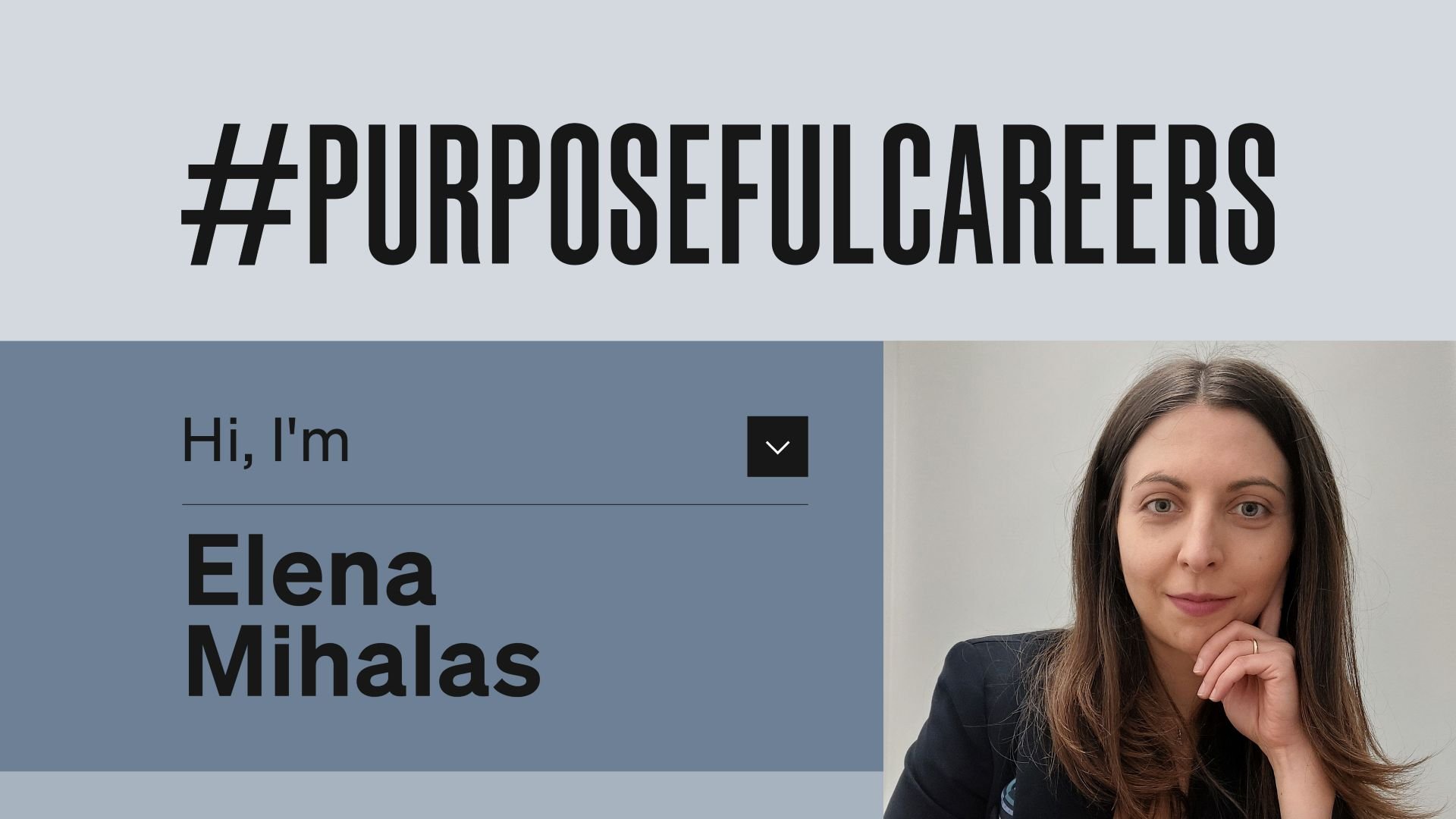
In this new chapter of Purposeful Careers, we meet Elena Mihalas, student of the International Flex Executive MBA, whose professional journey has evolved from technology consulting to leading AI adoption and organisational transformation initiatives.
Her experience highlights a key insight: successful transformation is rarely about technology alone. It is about helping people understand, embrace and trust change. From bridging the gap between technical execution and business impact to promoting more human-centred approaches to AI, her journey highlights the importance of connecting strategy, technology and people to create meaningful and lasting results.
A perspective that the International Flex Executive MBA helped strengthen, providing the financial, strategic and organisational foundations needed to operate at a broader level, while reinforcing her commitment to building more inclusive environments and empowering the next generation of women in technology.
Your career has evolved from a strong technical foundation into roles focused on AI adoption and organisational transformation. Looking back, what moments or challenges helped you realise that your purpose was not just building technology, but ensuring it works for people and organisations?
Early in my consulting career, I delivered a project that was, on paper, a success. The right methodology, a clean rollout, every box ticked. Months later, adoption was close to zero.
I kept witnessing deliverables fail at the same point: the moment they met people.
That pattern forced a question: If the technology works and the method is correct, what is missing?
The answer was uncomfortable. That gap is rarely technical. Many organizations reward the act of delivering a tool, because delivery is visible and gets rewarded, while the overall impact on business performance is easier to defer. Moreover, too many leaders avoid the work that actually drives adoption: the difficult conversations, the onboarding sessions they skip, the genuine curiosity about how people do their job and where they struggle. Some even keep the reasoning behind a decision to themselves, because being the only one who knows the "why" feels like an advantage.
I realised that governing a project only at the technical level would never allow me to address this gap. I had to start from the purpose, the strategy, the reasons behind the decisions, and then translate that vision for people, regardless of their role.
Reading people and reading a room came naturally to me. What I was missing was the financial, organizational, and strategic foundation to operate at a higher level. That is what POLIMI GSoM gave me.
In your work, you often navigate the gap between what technology can enable and what organisations are ready to embrace. What kind of impact do you want to generate in this space, and how do you see your role in shaping more human-centered, responsible approaches to AI in the future?
No serious business strategy is portable. Each company has its own history, its strengths, its failures, its niche, its ambition. Treating AI adoption as a universal upgrade ignores all of that.
The current pressure to adopt produces a great deal of motion and very little impact. The work I want to do starts one step earlier: deciding which questions are worth answering before deciding which technology to implement.
Two questions guide me.
First: how do we use AI to do better the thing we already do better than anyone else?
Second: how do we use AI to remove the tedious, repetitive work, so people have more room for the human interactions that build trust?
That second question matters most to me. Trust is built between people, not between a person and a system. Used well, AI should protect and expand that space, not replace it.
My role, as I see it, is to lead by example. Not to sell AI as inevitable, but to show what it looks like when the goal is to help and empower people through technology, rather than the reverse. The impact I want to generate is leaders and organisations that adopt AI on purpose because they have answered why, not only because everyone else is moving.
Alongside your professional path, you are also committed to mentoring women in tech and contributing to more inclusive environments. How has your experience at POLIMI Graduate School of Management helped you connect these different dimensions of your purpose, and what capabilities are you developing to create a broader and lasting impact?
I did not come to POLIMI GSoM to be empowered. I came to close some knowledge gaps: the financial, strategic, and commercial fluency that engineers are rarely given. What I left with was larger than the curriculum.
Sitting beside senior leaders, simulating real decisions, being wrong in the room and recovering, changed what I believed about myself. I stopped treating my own authority as something to question. The competence was real.
During the EMBA, my three selves stopped competing: the engineer who builds, the leader who aligns people, the woman who sets a life on her own terms. They became one way of working and showing up.
What I did not expect was how strongly I would feel the need to share what my career has taught me. I noticed that in my class, even at executive level, women were a minority. I know what it cost me to reach this point, and how much of that cost stays invisible. That is why I started to mentor women in tech: to help them see what no one names at their stage, and to empower them to be bold.
Culture changes when enough of us become visible and when we describe our struggles and our wins out loud. That is how the belief spreads: that women can build anything, and that our contribution enriches the overall perspective, making it more resilient.